
How to Evaluate a Fragrance Supplier for Home and Body Products
Evaluate a fragrance supplier the way you would hire a contractor: check the licence documents, verify the track record in your exact category, test the working relationship with one small project, and write the scope down. Most first-time founders pick a manufacturer on the price of a sample and discover the real costs later — in documentation gaps, communication lags and minimums that move. A supplier that survives a structured evaluation is usually the one that is easiest to work with for years, which is the actual qualification.
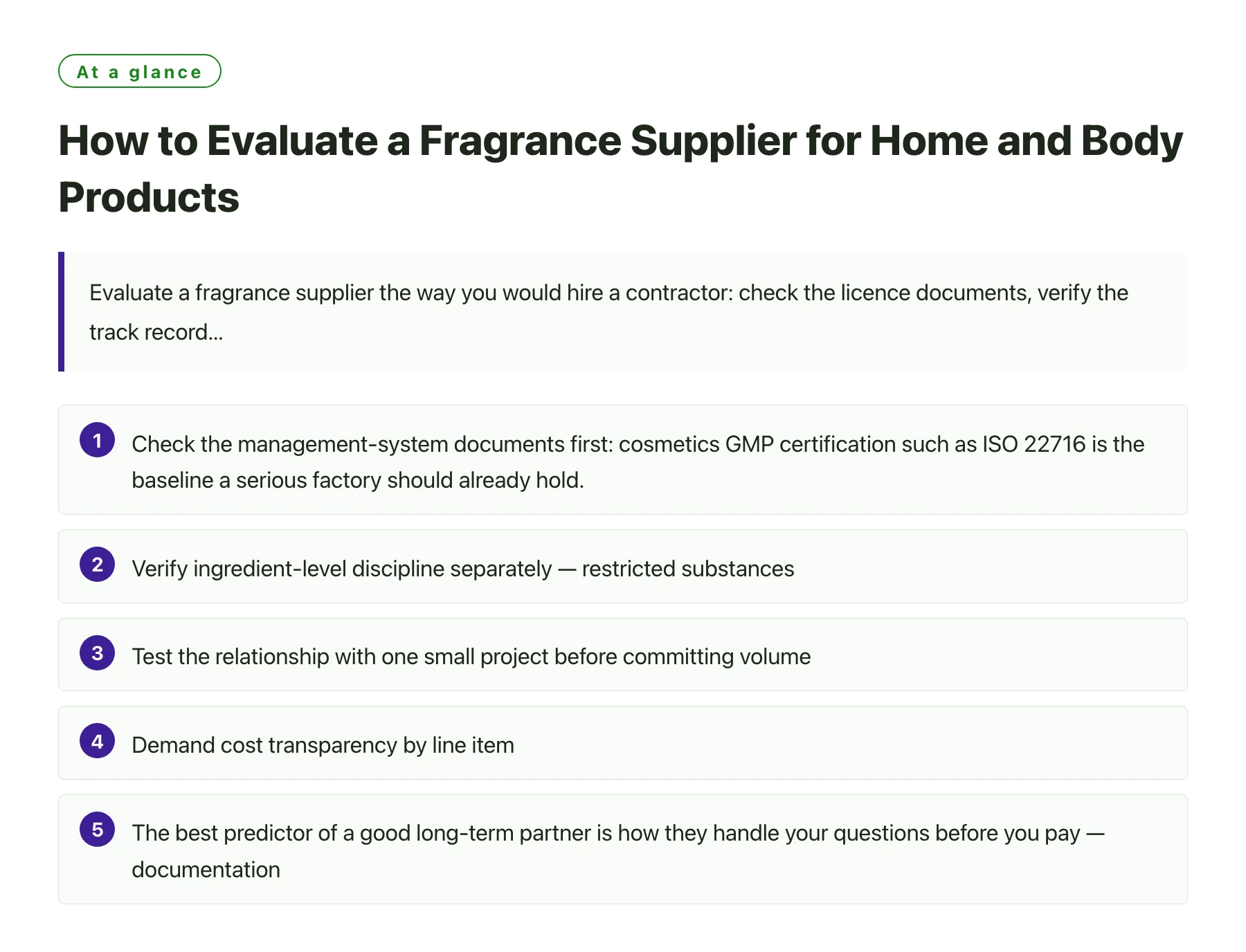
Key takeawaysCheck the management-system documents first: cosmetics GMP certification such as ISO 22716 is the baseline a serious factory should already hold. · Verify ingredient-level discipline separately — restricted substances, allergens and market-specific lists are formula questions, not factory questions. · Test the relationship with one small project before committing volume; sampling, quoting and paperwork reveal how a partner actually works. · Demand cost transparency by line item; a supplier that cannot price the components cannot control them either. · The best predictor of a good long-term partner is how they handle your questions before you pay — documentation, sample discipline and honest lead times.
Every founder starts the supplier search the same way: collect names, request quotes, compare numbers. Then the real evaluation begins — and it is rarely about the number.
This is a working framework rather than a grading rubric: four areas, in order, each with a pass criterion a first-time founder can actually apply.
Start with documents, not samples
The first screen is administrative. Does the supplier hold a recognised management-system certification for cosmetics production — ISO 22716 or equivalent — and can they show the certificate's scope and issuer? This is the layer that makes batch records possible in the first place, and it is the one third-party auditors check first [1].
If the scope line does not cover your category, keep looking or require evidence that it will be included: home fragrance is often treated differently from body products by regulators, and the audit scope should reflect the difference.
Then check ingredient discipline
Ingredients are where products actually get rejected in regulated markets. The EU maintains a cosmetic ingredient database where restricted and prohibited substances are listed, and the same thinking applies in most serious markets [2].
On top of legal lists sit the industry's own safety standards. The IFRA standards are the fragrance industry's reference for usage limits on fragrance materials, and a supplier should be able to confirm formula compliance against them [3].
Ask what you get with the sample: an IFRA statement, an allergen declaration, the ingredient list for your market. If the answer is later, the later always arrives with an invoice attached.
A four-area evaluation scorecard
| Area | Pass criterion | Typical failure |
|---|---|---|
| Management system | Certificate with number, issuer and scope; GMP-consistent batch records | Logo on the site, nothing on demand |
| Ingredient compliance | IFRA statement and ingredient list with the samples | Compliance only after ordering |
| Sampling discipline | Reference-based, documented rounds that match the brief | Verbal approvals, photos as evidence |
| Cost transparency | Line-item quote, minimums by component, change pricing | One number, everything else later |
| Communication | Written answers within days, one project owner | Disappearing contact, timezone guessing |
Score the supplier you have talked to, not the brochure. Two of the five rows will decide your experience within the first six weeks.
The trial project
The cheapest way to evaluate a partner is a small real project: one scent, one format, one market, fully documented. It exercises the quoting, sampling, testing and communication channels without the risk of a full order.
During the trial, watch how the supplier handles a change. The response to the second sample being slightly different from the first tells you more than any pitch: a manufacturer that builds custom scents on a documented workflow will show you the batch record and explain the drift, while an improviser will defend the sample a manufacturer that builds custom scents.
Also worth asking early is the route itself: a private label partner for perfume lines will quote you existing bases and formats, and that conversation is also a test of how the supplier scopes ownership and exclusivity a private label partner for perfume lines.
What the evaluation actually buys
The framework exists to buy one thing: fewer surprises over eighteen months. A supplier that fails the document check can still ship a good product once — and can equally fail to repeat it, which is the risk you are actually buying against.
Finally, use public sources as the cheapest screen. A manufacturer that publishes its scope, categories and certifications openly — like the Xuelei website does — has already answered several scorecard rows before you write the first email. That is not a recommendation; it is a method.
If you do nothing else, run the trial project before the volume commitment. One documented small order exposes in six weeks what an audit schedule exposes in six months — and it costs a fraction of a full first run.
Sources
- SGS: Cosmetics, Personal Care & Household Testing —— Testing, inspection and certification services for cosmetics and personal care, including microbiological, stability and safety testing aligned with cosmetics GMP.
- EU CosIng — Cosmetic Ingredient Database (European Commission) —— The European Commission's CosIng database of cosmetic ingredients, listing ingredient functions, restrictions and labelling requirements under EU cosmetics law.
- IFRA Standards Library (International Fragrance Association) —— The IFRA Standards Library lists the restrictions the fragrance industry applies to individual fragrance ingredients, based on safety assessments; it is the reference point for compliant fragrance formulation.
Frequently asked questions
What certifications should a fragrance supplier have?
Start with a cosmetics GMP management system such as ISO 22716 and ask for the certificate number, issuer and scope. Depending on your market you may also need HALAL or specific export-market dossiers — check with your importer first.
How do I check ingredient compliance myself?
Compare the ingredient list against the EU cosmetic ingredient database and the IFRA standards, and ask for the supplier's compliance statement in writing. A full assessment needs a lab or consultant, but the first screen you can do yourself.
How many samples should I ask for before choosing?
Make the first trial your evaluation: one or two rounds against a written brief. If the supplier delivers on spec with documentation, you have your answer; if not, the problem will not improve at volume.
What is the biggest evaluation mistake?
Evaluating the salesperson instead of the system. The quality of the sample, the batch record and the written quote are the evidence; the friendliness of the call is not.
Ready when you are