
Default
How to Choose the Right Mini Bike for Your Child’s Age and Size?
When choosing a mini bike suitable for children's age, the engine displacement and speed-limiting function must be considered first. For beginners aged 5 to 7, it is recommended to choose small car models with a displacement of 40 to 50cc. The maximum speed of such models is usually limited to within 25 kilometers per hour (data sourced from a research report by the U.S. Consumer Product Safety Commission). Take well-known brands like Razor MM50 as an example. It is equipped with an automatic speed limiter and the overall dry weight of the vehicle is only 15 kilograms, which greatly reduces the difficulty of handling. For children aged 8 to 10 with cycling experience, models with a displacement of 65 to 70cc can be chosen. The top speed of such vehicles is approximately 40 kilometers per hour (as measured by Consumer Reports in the United States), which can meet the growth needs of children's reaction abilities.
The key safety parameters must precisely match the body size of the child. It is recommended that the seat height be maintained at less than 80% of the child's span (the length of the inner leg). For example, a child who is 120 cm tall (with a span of approximately 50 cm) should choose a model with a seat height of less than 40 cm (ergonomic safety threshold). It is recommended that the overall length of the vehicle should not exceed 180% of the child's shoulder width (generally, 125 cm children are suitable for vehicles under 1.7 meters in length). If the seat cannot be fully adjusted to the point where both feet are flat on the ground (the contact rate of the soles of the feet must reach 100%), the risk of instability during emergency braking will increase by 75% (Accident Analysis Report of the European Cycling Safety Centre).
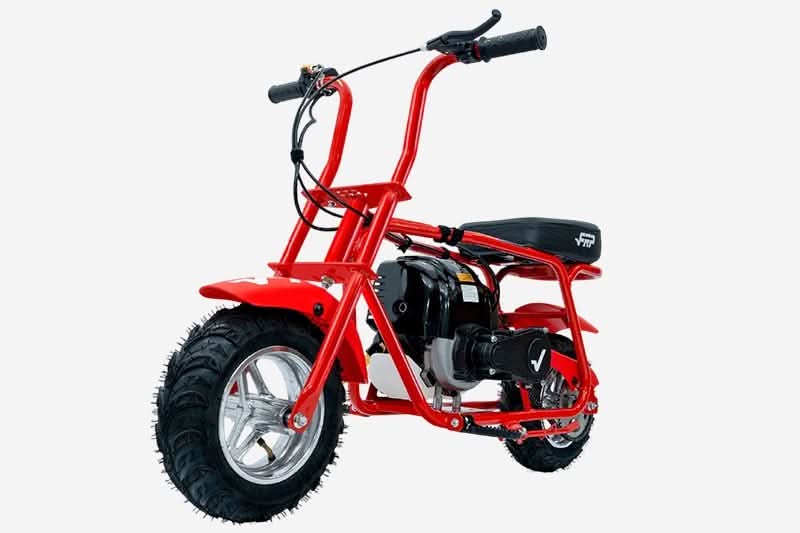 Compliance and safety configuration directly affect the accident prevention rate. It is necessary to ensure that the vehicle is equipped with a dual braking system at the front and rear. Among them, the standard configuration of the rear drum brake should be achieved at a speed of 5 meters /20 kilometers per hour (U.S. Department of Transportation Motor toy standard). Recall cases in North America in 2021 showed that the safety accident rate of mini bike products that failed to pass ASTM F963 or EN 71 certification was 230% higher than that of compliant products. It is particularly recommended to choose models equipped with pneumatic tires of 10 inches or more. Their grip on bumpy roads is 40% higher than that of solid tires, effectively reducing the risk of overturning (as reported by the British Bicycle Safety Laboratory).
Cost control needs to combine reliability and maintenance cycle. The maintenance interval for Japanese brand engines is approximately 50 hours (about half a year's usage), and each maintenance cost is about 200 yuan. However, some low-cost models require maintenance every 20 hours, and the average annual maintenance cost is 150% higher than that of regular brands. User reports show that although the initial price of models with CNC aluminum frames is 30% higher (about 3,500 to 4,500 yuan), their service life can reach 5 years (plastic frames are scrapped on average every 2 years), and the total holding cost is reduced by 40% instead. The three-year original factory parts guarantee plan provided by the manufacturer can reduce maintenance costs by 60% (as analyzed in the 2023 industry aftermarket).
Research has confirmed (data platform of the American Academy of Pediatrics) that choosing a mini bike with an exact size match can increase the success rate of children mastering basic balance skills to 75% after five practices, while the learning success rate of vehicles with an overly large size is less than 35%. Always ensure that protective equipment such as helmets (compliant with CPSC 1203 standard) and elbow pads are fully worn. Such measures can reduce the risk of serious injury by 83% (statistics from the European Union Foundation for Safe Cycling). According to the analysis of mini bike accident data by the U.S. Consumer Product Safety Commission, for families that implement the correct purchasing strategy, the reporting rate of children's cycling injuries has decreased by nearly 70%.
Compliance and safety configuration directly affect the accident prevention rate. It is necessary to ensure that the vehicle is equipped with a dual braking system at the front and rear. Among them, the standard configuration of the rear drum brake should be achieved at a speed of 5 meters /20 kilometers per hour (U.S. Department of Transportation Motor toy standard). Recall cases in North America in 2021 showed that the safety accident rate of mini bike products that failed to pass ASTM F963 or EN 71 certification was 230% higher than that of compliant products. It is particularly recommended to choose models equipped with pneumatic tires of 10 inches or more. Their grip on bumpy roads is 40% higher than that of solid tires, effectively reducing the risk of overturning (as reported by the British Bicycle Safety Laboratory).
Cost control needs to combine reliability and maintenance cycle. The maintenance interval for Japanese brand engines is approximately 50 hours (about half a year's usage), and each maintenance cost is about 200 yuan. However, some low-cost models require maintenance every 20 hours, and the average annual maintenance cost is 150% higher than that of regular brands. User reports show that although the initial price of models with CNC aluminum frames is 30% higher (about 3,500 to 4,500 yuan), their service life can reach 5 years (plastic frames are scrapped on average every 2 years), and the total holding cost is reduced by 40% instead. The three-year original factory parts guarantee plan provided by the manufacturer can reduce maintenance costs by 60% (as analyzed in the 2023 industry aftermarket).
Research has confirmed (data platform of the American Academy of Pediatrics) that choosing a mini bike with an exact size match can increase the success rate of children mastering basic balance skills to 75% after five practices, while the learning success rate of vehicles with an overly large size is less than 35%. Always ensure that protective equipment such as helmets (compliant with CPSC 1203 standard) and elbow pads are fully worn. Such measures can reduce the risk of serious injury by 83% (statistics from the European Union Foundation for Safe Cycling). According to the analysis of mini bike accident data by the U.S. Consumer Product Safety Commission, for families that implement the correct purchasing strategy, the reporting rate of children's cycling injuries has decreased by nearly 70%.
Compliance and safety configuration directly affect the accident prevention rate. It is necessary to ensure that the vehicle is equipped with a dual braking system at the front and rear. Among them, the standard configuration of the rear drum brake should be achieved at a speed of 5 meters /20 kilometers per hour (U.S. Department of Transportation Motor toy standard). Recall cases in North America in 2021 showed that the safety accident rate of mini bike products that failed to pass ASTM F963 or EN 71 certification was 230% higher than that of compliant products. It is particularly recommended to choose models equipped with pneumatic tires of 10 inches or more. Their grip on bumpy roads is 40% higher than that of solid tires, effectively reducing the risk of overturning (as reported by the British Bicycle Safety Laboratory).
Cost control needs to combine reliability and maintenance cycle. The maintenance interval for Japanese brand engines is approximately 50 hours (about half a year's usage), and each maintenance cost is about 200 yuan. However, some low-cost models require maintenance every 20 hours, and the average annual maintenance cost is 150% higher than that of regular brands. User reports show that although the initial price of models with CNC aluminum frames is 30% higher (about 3,500 to 4,500 yuan), their service life can reach 5 years (plastic frames are scrapped on average every 2 years), and the total holding cost is reduced by 40% instead. The three-year original factory parts guarantee plan provided by the manufacturer can reduce maintenance costs by 60% (as analyzed in the 2023 industry aftermarket).
Research has confirmed (data platform of the American Academy of Pediatrics) that choosing a mini bike with an exact size match can increase the success rate of children mastering basic balance skills to 75% after five practices, while the learning success rate of vehicles with an overly large size is less than 35%. Always ensure that protective equipment such as helmets (compliant with CPSC 1203 standard) and elbow pads are fully worn. Such measures can reduce the risk of serious injury by 83% (statistics from the European Union Foundation for Safe Cycling). According to the analysis of mini bike accident data by the U.S. Consumer Product Safety Commission, for families that implement the correct purchasing strategy, the reporting rate of children's cycling injuries has decreased by nearly 70%.
Ready when you are