
A Beginner's First Month in Bitcoin Mining, Priced Out
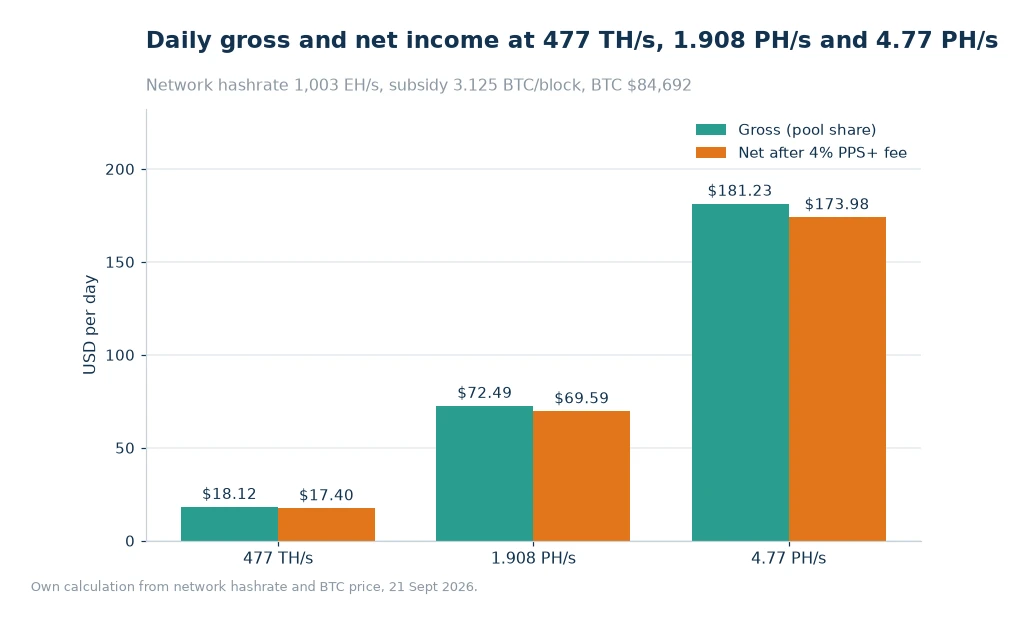
The first month of mining is a learning period that happens to have a power bill attached. A 477 TH/s machine earns 0.00021399 BTC a day at current network output, about $18.12 gross and $17.40 after the listed 4% on the block-reward component. That is enough to learn the workflow and not enough to justify rushing the setup.

Key takeaways
- At 477 TH/s the network pays $18.12 gross and $17.40 net a day at BTC $84,692.
- Ten thousandths of a bitcoin takes about 46.7 days at that hashrate, so a first month is a fraction of a target.
- Power, cooling and a spare fan belong in the budget before the machine is ordered.
- A written stop rule, such as two weeks below break-even, prevents a learning period from becoming an expensive habit.
Start with the coin output, not the price chart
New miners tend to begin with a price forecast and work backwards to a machine. The order is wrong. The output of a given hashrate at a given difficulty is knowable today, while the price next month is not. Build the plan on the knowable part first, then treat the coin price as the variable that decides how good the month was.
This habit also makes the first month calmer. If the daily coin output matches the arithmetic, the operation is working. A falling dollar value is a market event, not a setup error, and the response is different. Separating the two prevents a beginner from rebuilding a perfectly good configuration because the price moved.
The four inputs you cannot skip
Every honest estimate needs four things: the network hashrate, the block subsidy and daily block count, your own hashrate, and the fee that applies to the component being paid. At the 21 September 2026 reading, the network was about 1,003 EH/s, the subsidy was 3.125 BTC, and 144 blocks a day gave 450 BTC of issuance. Your hashrate is the number on the machine, measured rather than assumed.
The fourth input is the one beginners get wrong. PPS+ applies a listed 4% to the block-reward component and a listed 2% to the transaction-fee component, so a single blended rate will misstate the result. Use the component rates and say which one you applied. A spreadsheet that shows its inputs can be corrected later; one that shows only a final number cannot.
What one machine actually returns
A single 477 TH/s unit is a small slice of a very large network. Its share is about 4.75 billionths of total hashrate, which is why the daily coin amount has five zeros after the decimal point. That is not a flaw in the setup; it is the scale of Bitcoin mining in 2026. The number becomes meaningful when it is multiplied by days and by a coin price.
The first month should be judged on uptime as much as on output. A machine that runs 95% of the month produces about 5% less than the arithmetic suggests, and the gap is a setup lesson rather than a loss to recover. Check the pool dashboard daily for the first two weeks, then weekly once the pattern is stable. The habit is the real product of month one.
Multi-coin breadth without a second account
Bitcoin is the usual starting point, but the same account can point hardware at other coins when the economics differ. A multi-coin pool supports more than twenty assets, including BTC, BCH, LTC and DOGE through merged mining, KAS, ZEC, HNS, CKB and ETC. Opening a ViaBTC Crypto Mining account keeps the dashboard, the wallet and the payout history in one place while the coin changes.
Breadth is not a reason to switch constantly. Each coin has its own difficulty, price and hardware fit, and a switch costs time and sometimes a firmware change. The useful version of breadth is a shortlist of two or three coins you understand, with a rule for when to move. A beginner with one coin and a working setup is in better shape than one with five half-configured workers.
Costs a beginner forgets to count
The machine is the visible cost. The invisible ones are cooling, noise mitigation, network equipment and the replacement parts that fail in the first year. A fan is cheap until it fails on a hot weekend; a surge protector is cheap until it is needed. Put a small contingency in the first-month budget and treat it as part of the setup rather than as an unexpected loss.
There is also a time cost. Monitoring, firmware updates and pool configuration take hours, and those hours have a value even if no invoice is raised. A beginner who tracks them will make a better decision about whether to expand, hold or stop. The number does not need to be precise; the awareness does.
The table converts the three hashrate tiers into the time needed to reach a small BTC target, which is a more intuitive measure for a new operator than a daily fraction.
| Hashrate | BTC per day | Days to 0.01 BTC | Net per day |
|---|---|---|---|
| 477 TH/s | 0.00021399 | 46.7 | $17.40 |
| 1.908 PH/s | 0.00085595 | 11.7 | $69.59 |
| 4.77 PH/s | 0.00213985 | 4.7 | $173.98 |
A first-month plan with a stop rule
Write three lines before the machine arrives. The first is the expected daily net at current difficulty. The second is the all-in daily power cost. The third is the stop rule: for example, if the net stays below the power cost for fourteen consecutive days, the machine is switched off and the plan is reviewed. The rule removes the daily argument with yourself.
Review the rule at the end of the month using real numbers, not the estimate. If the machine beat the estimate, the difference is usually uptime or a favourable difficulty move, and both are worth understanding. If it missed, the cause is usually heat, a tariff band or a configuration error. Either way, month two starts with evidence.
Worked example
Take the 477 TH/s unit and follow it to the target time.
- Network issuance: 3.125 × 144 = 450 BTC a day.
- Output belonging to a single TH/s: 450 ÷ 1,003,100,000 = 0.00000044861 BTC.
- At 477 TH/s: 477 × 0.00000044861 = 0.00021399 BTC.
- USD: 0.00021399 × 84,692 = $18.12 gross.
- Listed 4% on the block-reward component: $18.12 × 0.04 = $0.72, leaving $17.40.
- Days to 0.01 BTC: 0.01 ÷ 0.00021399 = 46.73.
- At 1.908 PH/s the daily figure is 0.00085595 BTC, so the target takes 0.01 ÷ 0.00085595 = 11.68 days.
- At 4.77 PH/s it is 0.00213985 BTC a day, so the target takes 0.01 ÷ 0.00213985 = 4.67 days.
Frequently asked questions
How much can a beginner earn in the first month?
At 477 TH/s and continuous uptime the coin output is about 0.00642 BTC over thirty days, worth roughly $522 net at the chart's $17.40 daily figure, before power and setup costs.
Do I need special hardware to start?
You need an ASIC that matches the coin you intend to mine, a stable power supply, adequate ventilation and a network connection; the pool account and wallet are software steps that take minutes.
What is the biggest beginner mistake?
Buying before measuring. A machine chosen without checking the local tariff, the noise limit and the cooling options can be profitable on paper and unusable in the room where it has to live.
Start small enough to learn from
One machine, one month, one written rule. That is enough to learn the workflow without committing a year of power cost to an untested assumption. If the month works, expand with the same measurement discipline. If it does not, you have lost a small amount and gained a clear answer. The Profit Calculator will re-run the revenue side for any hashrate, and the wallet keeps the first coins separate from the rest of your holdings.
Sources: ViaBTC pricing, calculator, wallet and pool pages for supported coins and the component rates. Chain data checked 21 Sept 2026: 1,003 EH/s network hashrate, 132.76 T difficulty, 3.125 BTC subsidy, 144 blocks per day, BTC $84,692. Published 24 Oct 2026; power costs are excluded and uptime is assumed continuous[1].